Ben Shoesmith
Game Designer
Based in Knaresborough, UK
Professional and Experienced Remote Worker
Professional and Experienced Remote Worker
-poster-00001.jpg)
.jpg)
I feel that compassion plays a big part in the long term success of any project. The balance between compassionate leadership and delivering results is a hard line to tow, but a fruitful one if towed successfully.
Hard work, self-discipline, and an unsatisfiable desire to improve have allowed me to progress to where I am now, and I know will take me to unrecognisable levels in the future. Such development is driven by a love of games and the need to provide fulfilling gaming experiences to players akin to the experiences that have warmed my memories.

Adopting a matchmaking system and economy with minimal assistance at Exient for Ultimate Sackboy has allowed me to challenge myself in the area of Technical Design, and pushed me to deliver high-quality results in short timeframes that impact a live game. My expertise in Excel and Google Sheets allowed me to also create a simulated economy and player progression experience to identify potential pain points in the player journey.

Turning what was originally a short-term task into my own area of Ultimate Sackboy that I'm solely responsible for has allowed me to strongly develop my level design abilities and create guidelines for future level designers on the game to follow in order to deliver levels of the highest quality.

Brimming with passion for this aspect of Game Design, I have an excellent understanding of what drives players to return to games.

In my university studies I became very familiar with Unity and Unreal Engine, learning to code in C# and C++ and utilise these skills to produce prototypes. I favour Unreal Engine and am particularly skilled in blueprinting as well as creating widgets.

I started my journey into digital art during secondary school where I made Youtube artwork for friends. From there I have progressed to creating high-quality concept art pieces, callout sheets and accurate readable design document mockups.


.svg.png)






By applying a camera view of a widget to a material and applying that material to an object I've been able to create an immersive computer interaction for players where the last screen they entered will remain once exited. With a working audio player, template image and text documents and the ability to download files to access them at different computers using a CSV collectible sheet, this prototype is close to finished with just some minor polish left to complete.
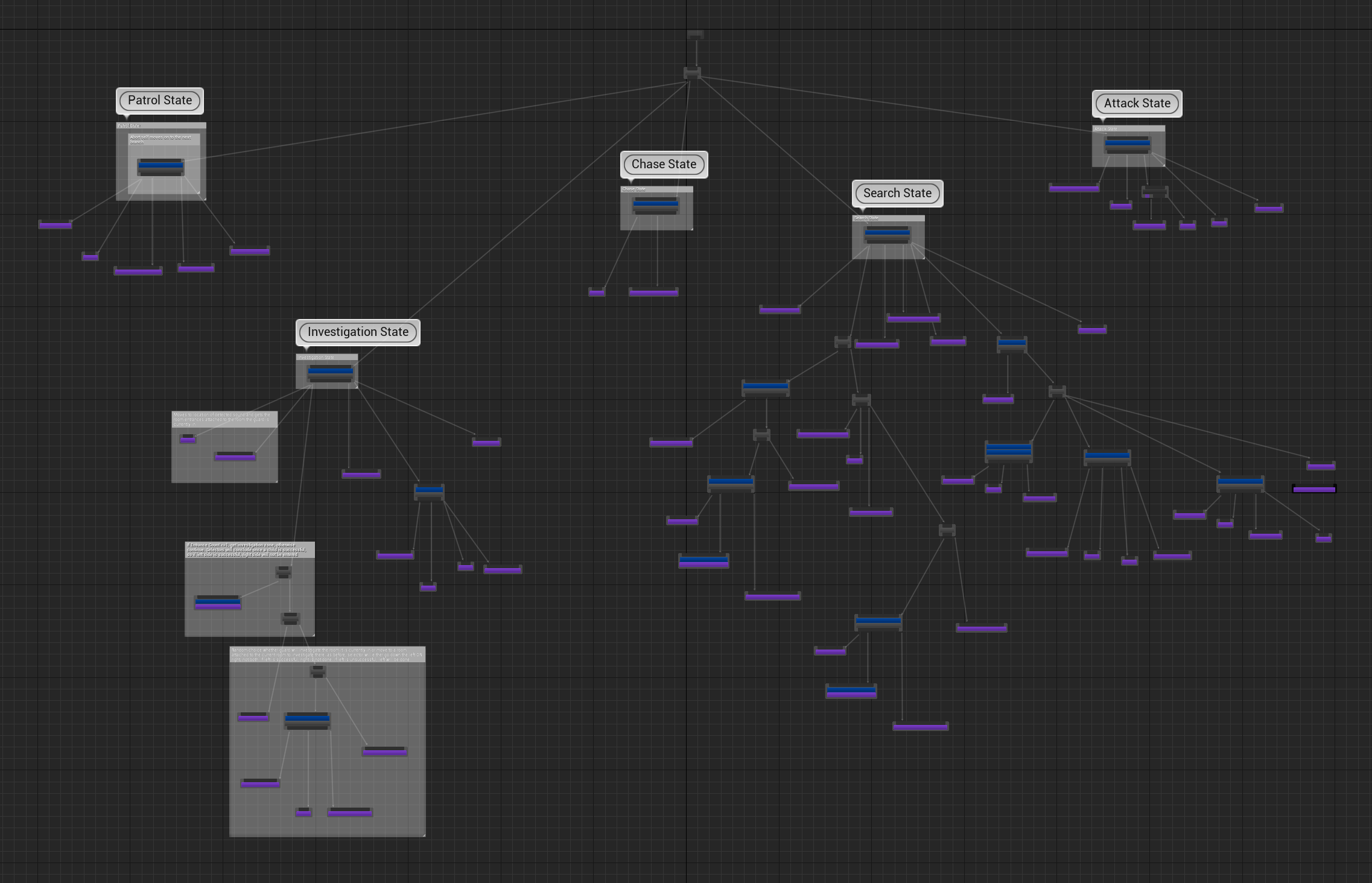
Jumping into behaviour trees and AI blueprints has helped me to learn the intricacy and abundance of edge cases in design and development of AI characters. This system needs some perception adjustments in order to work as intended, however, currently this Behaviour Tree allows a character to detect using sight and hearing, search design-chosen points of interest in a network of level areas, search lockers and other hideable objects for the player, and chase and attack the player.

I created a network of systems that communicate to allow players to activate power to all powered assets within particular rooms of a level. The system uses the same widget setup as the Gamespace Terminal UI. When power is chosen for a room, the total allocated power is shown and the map shows rooms with and without power. This example shows that toggling the "Lobby" button turns the light by the terminal on and off.
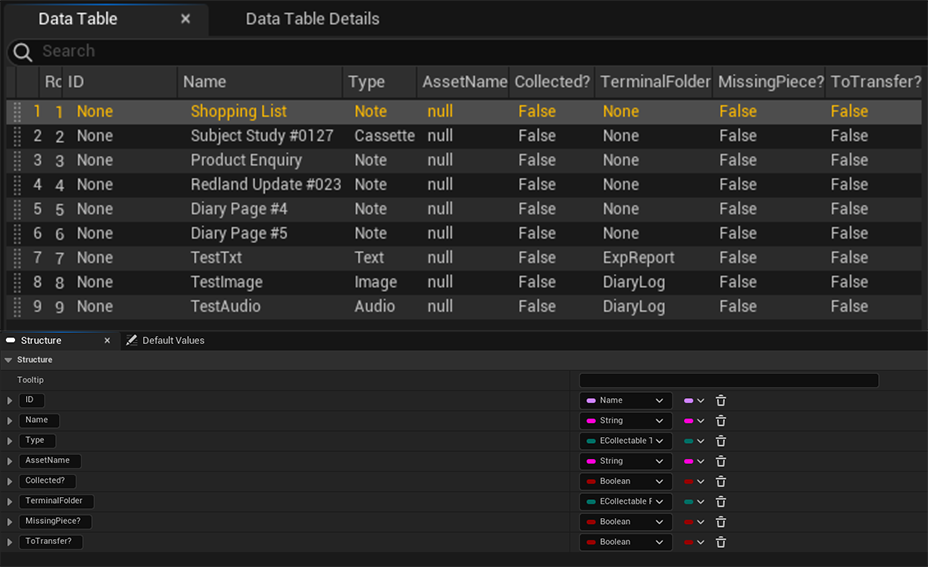
Using a CSV file I populated a data table with collectible structures. When collectibles are obtained, a game instance Save Game event is called, saving the updated collectible data to a save slot. The data table is set up so that additions to the CSV file can be reimported and the data table will update. These collectibles can be picked up as objects in the game world or downloaded from the Gamespace Terminal UI system.
Here is some more information about me as a person, as well as some quotes from people who I have worked and studied with.